 नेपालब्रिटेन संवाददाता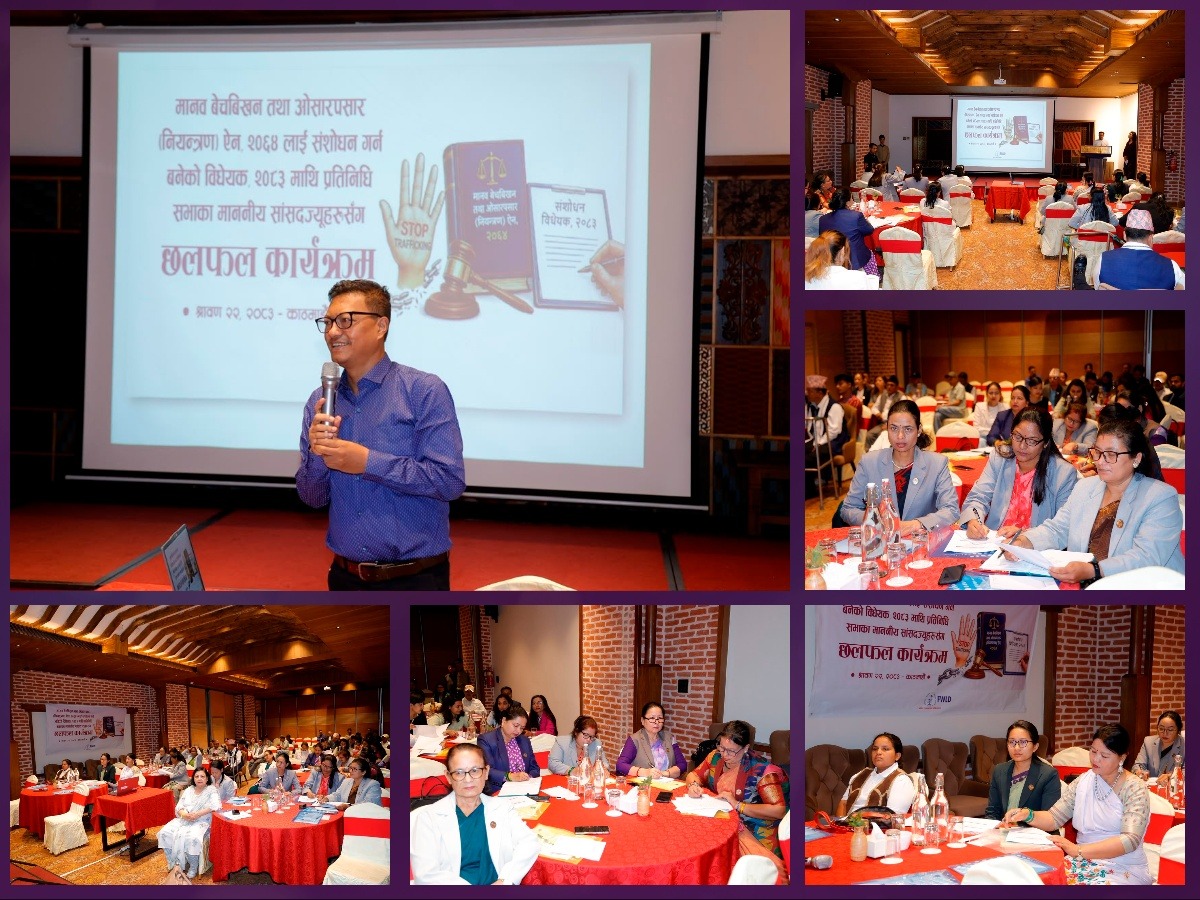
Kathmandu: Participants at a discussion on the bill to amend the Human Trafficking and Transportation (Control) Act, 2007, emphasized the need to make the proposed legislation relevant to current realities.
The Women, Law and Development Forum (FWLD) organized the discussion with members of the House of Representatives on the proposed amendment bill. Participants said the bill had addressed several important issues, but further improvements were necessary to make its provisions more effective and relevant to the changing nature of human trafficking.
Advocate Sabin Shrestha, Executive Director of FWLD, said the Human Trafficking and Transportation (Control) First Amendment Bill, 2083, which was scheduled to be presented in the House of Representatives on Friday by Minister for Women, Children, Gender and Sexual Minorities Sita Badi, could be made more relevant by amending an additional 22 provisions.
The discussion proposed a comprehensive review and amendment of provisions under Section 1(3), Section 2, Section 4, Section 5, Section 8(a), Section 11, Section 12, Section 13, Section 14, Section 15, Section 17, Section 20(a), Section 22, Section 23, Sections 23(a) and 23(b), Section 25, Section 26, Section 27, Sections 27(a) and 27(b), and Section 29(a).
Lawmakers were urged to pay close attention to the changing dimensions of human trafficking and transportation while drafting and amending legislation.
Recalling that the Human Trafficking and Transportation Act, 2007 evolved from the Human Trafficking Act introduced in 1986, Executive Director Shrestha said, “The amendment bill has been introduced 20 years after the existing law was enacted. It is now necessary to amend the law in line with international legal standards because human trafficking and transportation are no longer confined within Nepal.”
Nepal is a party to the Palermo Protocol, and the country has become not only a source country but also a destination for human trafficking. Therefore, Shrestha stressed the need to take international treaties and agreements into consideration while amending the legislation.
Speaking about the objective of the discussion, FWLD’s Binod Chandra Devkota said that although all three levels of government have their own mechanisms and laws concerning human trafficking and transportation, there is still a lack of clarity. He also questioned whether human trafficking and human transportation should be treated as separate activities.
Devkota said the discussion was organized because improvements were needed in the language used in the bill as well as in several other provisions.
During the program, lawmaker Prem Bahadur Baijak shared cases of human trafficking reported in Cambodia and Australia and sought suggestions on what provisions could be incorporated into the bill to prevent such incidents from recurring.
Lawmaker Sushila Dhakal Acharya sought suggestions on how legal assistance could be provided to victims living abroad.
Lawmakers Bishnumaya Pariyar, Sajda Siddiqui, Yasoda Baral, Pavitra Bishwakarma, Radhika Ramteel, Sirjana Shrestha, Prabha Karki, Saraswati Lama and Khemraj Koirala discussed the various dimensions of human trafficking and transportation in Nepal.
They said women and children continue to be the most affected groups, while men have also increasingly become victims in recent years. They emphasized that the amended law should be inclusive and address the needs of all victims.
FWLD facilitated the lawmakers in reviewing the existing provisions of the Act and the changes proposed in the amendment bill, as well as discussing what provisions should be added, removed or improved.
The participants said the discussion, attended by more than five dozen lawmakers, marked an important step toward a deeper understanding of the Human Trafficking and Transportation (Control) First Amendment Bill.