 नेपालब्रिटेन संवाददाता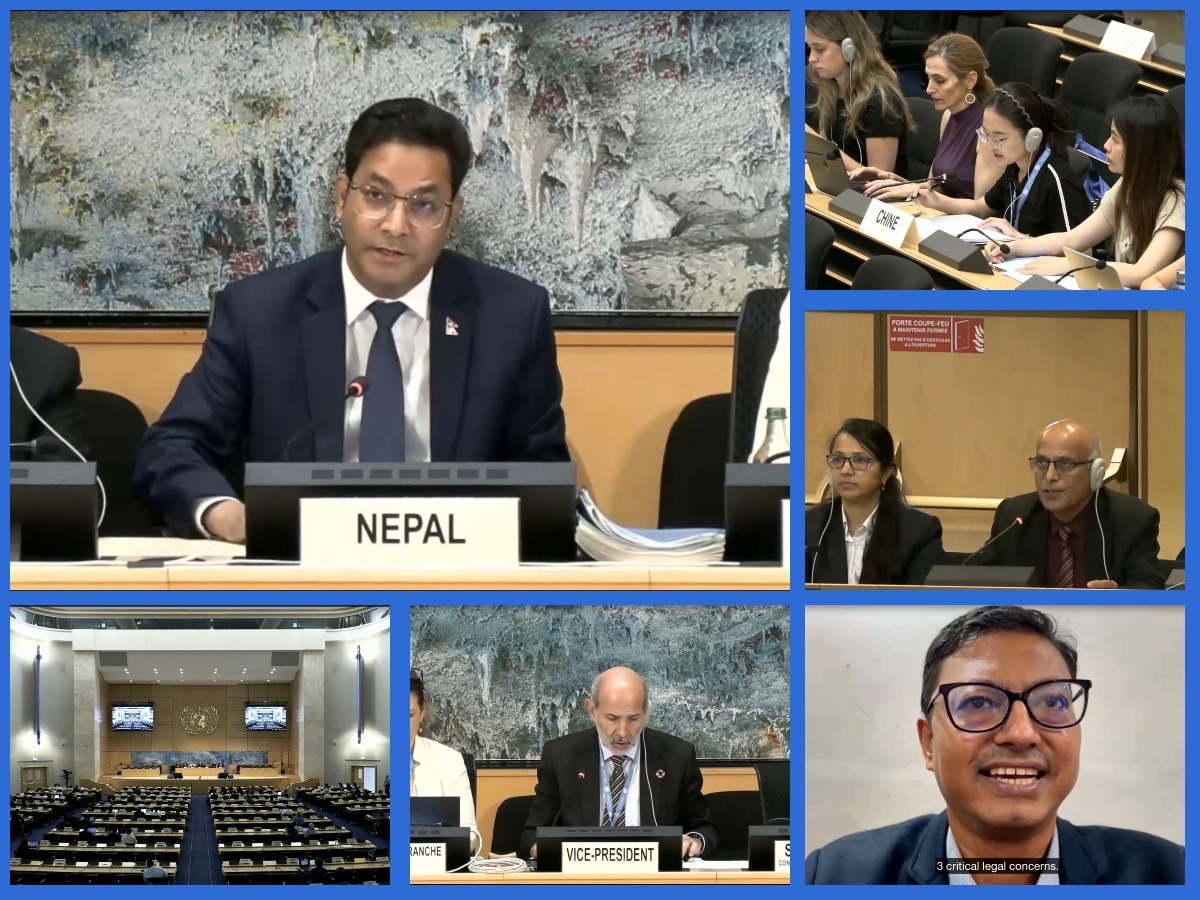
Kathmandu – Nepal’s report under the fourth cycle of the Universal Periodic Review (UPR) was formally adopted on 30 June 2026 during the 62nd Session of the United Nations Human Rights Council in Geneva.
The session was attended by Nepal’s Permanent Representative to the United Nations in Geneva, Ambassador Ram Prasad Subedi, National Human Rights Commission member Mihir Thakur, representatives of UN member states, UN agencies, and civil society organizations.
Representing civil society, Advocate Sabin Shrestha, on behalf of the Forum for Women, Law and Development (FWLD) and Equality Now, delivered a joint oral statement highlighting three major legal reform priorities in Nepal.
Expanding the Legal Definition of Rape
The first issue raised concerned the need to amend Nepal’s National Penal Code to broaden the legal definition of rape.
The statement argued that the current legal framework does not fully recognize all forms of non-consensual sexual penetration. Civil society organizations urged Nepal to adopt a consent-based definition of rape in line with international human rights standards so that all forms of non-consensual sexual acts are legally recognized as rape.
Removing the Statute of Limitations for Rape Cases
The second key concern was the statute of limitations for filing rape complaints.
Civil society emphasized that survivors are often unable to report sexual violence within the legally prescribed time due to social stigma, intimidation, psychological trauma, and limited access to justice. This is particularly true for survivors of conflict-related sexual violence.
The organizations therefore called for the complete removal of the statute of limitations for rape cases.
Legal Protection for Women in the Informal Sector
The third issue focused on Nepal’s Sexual Harassment at Workplace (Prevention) Act, 2015 (2071 BS).
According to the statement, the law is primarily effective in the formal employment sector, leaving domestic workers, agricultural laborers, construction workers, and other women employed in the informal economy without adequate legal protection.
Civil society urged the Government of Nepal to amend the legislation so that it applies equally to workers in both formal and informal sectors.
International Recommendations to Nepal
Nepal underwent its fourth-cycle UPR review on 21 January 2026, and on 3 February 2026, the UPR Working Group issued 284 recommendations covering a wide range of human rights issues.
Several of these recommendations reflected proposals contained in four alternative reports submitted by FWLD to the UN Human Rights Council in July 2025. Those reports focused on:
Sexual and reproductive health and rights;
Children’s rights;
Sexual violence against women and girls; and
The rights of persons with disabilities.
Among the recommendations:
Brazil, The Gambia, and Ireland called on Nepal to amend child marriage laws by recognizing children involved in child marriages as victims rather than offenders and prioritizing their rehabilitation instead of criminal prosecution.
Iceland, France, and Germany recommended further decriminalizing abortion, strengthening sexual and reproductive health rights, and introducing legal reforms to address obstetric violence.
Bulgaria urged Nepal to ensure equal access to healthcare for persons with disabilities, strengthen the National Disability Fund, and expand rehabilitation services.
Nepal Accepts Majority of Recommendations
Out of the 284 recommendations received, Nepal formally accepted 225, noted 57, and provided comments on two recommendations.
The recommendations accepted through the UPR process now form part of Nepal’s international human rights commitments. Their effective implementation will be crucial in strengthening human rights protection, advancing legal reforms, and improving access to justice across the country.