 नेपालब्रिटेन संवाददाता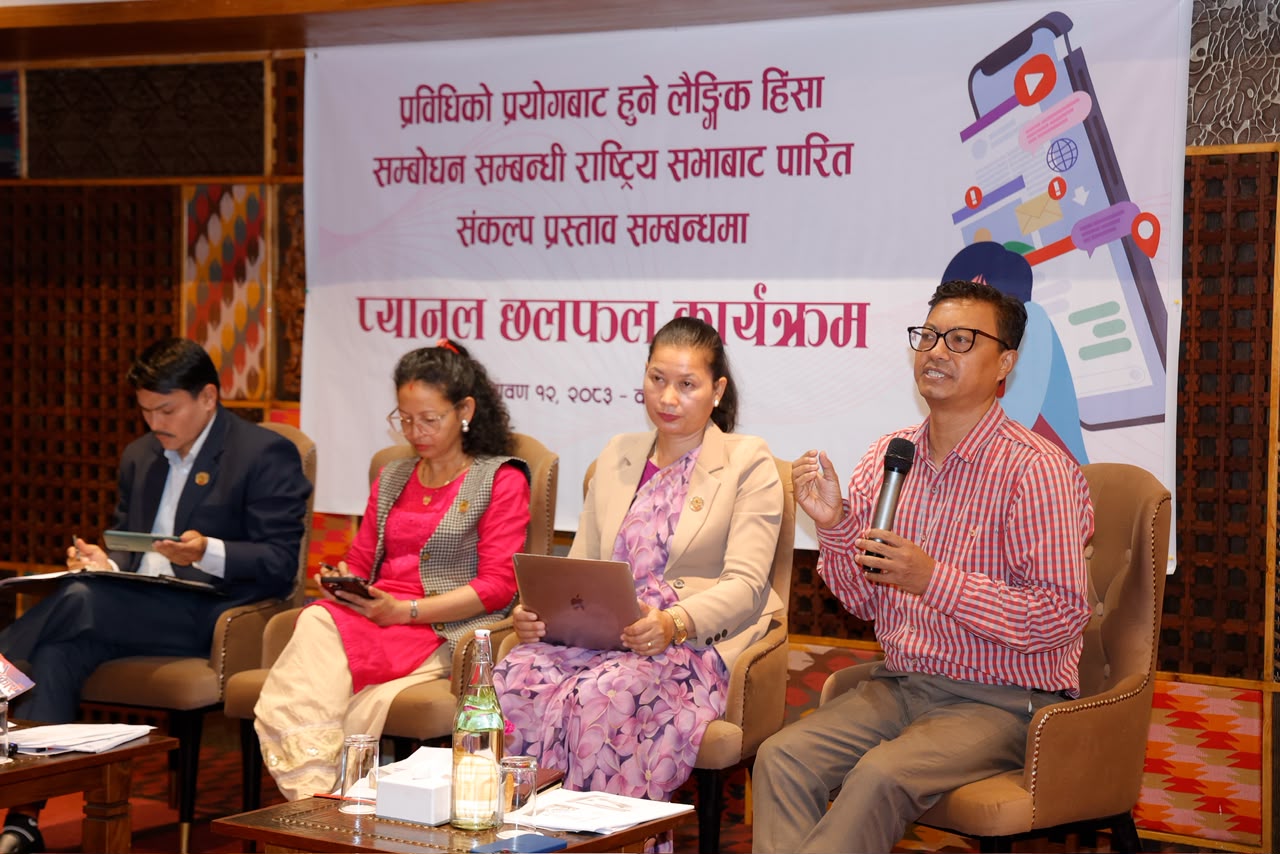
Kathmandu: Speakers at a panel discussion in Kathmandu on Tuesday stressed the need for Nepal to formulate laws, in line with international treaties and agreements, to make social media platforms more accountable.
The discussion, organized by the Forum for Women, Law and Development (FWLD), focused on the resolution passed by the National Assembly regarding the response to technology-facilitated gender-based violence.
Renu Chand, the proposer of the resolution that was unanimously endorsed by the National Assembly on Asar 17 (Nepali calendar), said that failing to introduce legislation to regulate social media—now a major platform for freedom of expression—could create serious challenges. She said the resolution was tabled to encourage the government to expedite the drafting of laws after the absence of legal provisions began undermining freedom of expression.
The resolution was supported by lawmakers Padam Bahadur Pariyar and Roshani Meche and contains seven key recommendations.
Lawmaker Pariyar said that women and children are the primary victims of digital violence. He noted that incidents of online abuse are increasing while Parliament has yet to enact the necessary legislation. He also pointed out the lack of a state mechanism to adequately address victims’ concerns, making the resolution particularly significant.
Lawmaker Meche said the resolution would assist the government in drafting legislation and raise awareness about the impact of digital violence on society. She explained that once the resolution is adopted, the concerned ministry will be required to submit progress reports to the National Assembly every three months. Parliamentary committees will monitor implementation, while the media can also contribute to reducing digital violence.
Participants observed that although social media has empowered people to exercise their rights, its misuse has also grown significantly. FWLD Executive Director and advocate Sabin Shrestha said it was unfortunate that Nepal was still debating information technology and cyber security legislation more than two decades after social media became widely used.
“Technology has advanced rapidly, yet we are only now discussing the necessary legal framework,” Shrestha said. “Cases of digital violence are increasing dramatically every day, but social media platforms have not been made sufficiently accountable.”
Representing civil society, Shrestha said implementing the National Assembly’s resolution would mark a major milestone. He revealed that 18,926 cases of violence were registered with the police during fiscal year 2081/82 (Nepali calendar), with more than 17,000 cases (over 85 percent) recorded in Kathmandu. Of these, only 218 cases (about 1.5 percent) proceeded to prosecution. He argued that the lack of appropriate legislation has denied justice to many victims.
Speakers described the National Assembly’s resolution as the starting point of a broader campaign to reduce digital violence. Participants recommended strengthening police capacity, expanding public awareness campaigns, and advocating for comprehensive legislation that addresses the needs of all sectors, communities, and social groups.
Journalists Binu Shrestha and Manjima Dhakal of The Rising Nepal, Aakanksha Dhami of News Bank, Avaji Paudel of Annapurna Post, advocate Diksha Raut, Madhu Shahi of Rastriya Samachar Samiti (RSS), and Anushka Dhami of Kendrabindu, among others, raised questions about the resolution and the growing challenge of digital violence. The discussion was moderated by Kamala Panthi, President of Sancharika Samuha.
Key Provisions of the Resolution
The resolution directs the Government of Nepal to implement the following seven measures:
Legally define emerging and evolving forms of technology-facilitated gender-based violence and amend existing laws or enact new legislation accordingly.
Introduce a special legal framework covering victim protection, rehabilitation, investigation, prosecution, and compensation.
Include digital rights, online safety, and cyber awareness in school and university curricula.
Conduct regular digital literacy and cyber security campaigns nationwide, extending to the local government level.
Strengthen institutional mechanisms for victim-friendly complaint systems, preservation of digital evidence, and speedy justice.
Enhance the capacity of investigative agencies, government attorneys, and judicial institutions to effectively investigate and prosecute technology-related violence.
Legally require social media platforms and internet service providers to promptly remove harmful content and cooperate with investigations into digital violence.