 नेपालब्रिटेन संवाददाता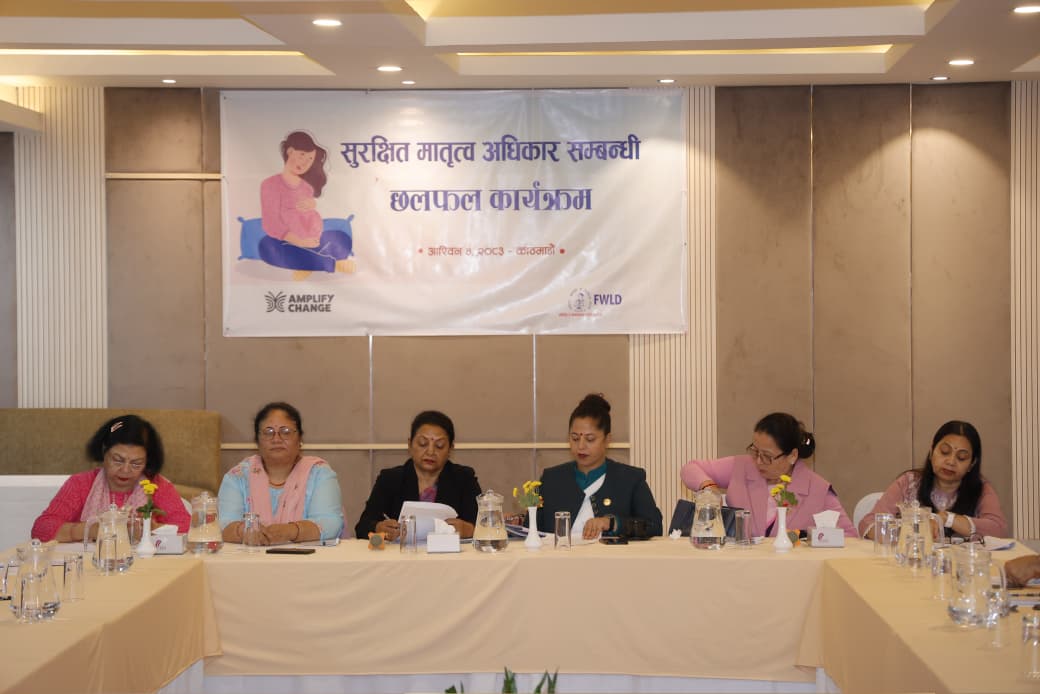
Kathmandu: A motion of urgent public importance registered in Parliament calling for maternity leave to be extended to six months has been described as a measure that would benefit all mothers, from women working in physically demanding jobs such as stone breaking to government employees.
The remarks were made during a discussion on safe motherhood rights organized by the Forum for Women, Law and Development (FWLD). Member of Parliament Sita (Urmila) Thapaliya, who proposed the motion, said it was introduced with the objective of benefiting all new mothers.
Thapaliya urged stakeholders to view the parliamentary motion in the broader context of producing healthy citizens and protecting human rights. She said the proposal should be taken positively as it is directly linked to the health of citizens.
“This is a beginning, and we need to move forward by discussing its impractical aspects,” Thapaliya said. “This proposal has not been introduced arbitrarily. It is an issue that has been discussed and researched for a long time. Parliament should give it legal status.”
MP Saraswati Lama, a supporter of the motion, said it was registered in Parliament following six months of efforts. She said all lawmakers support the proposal and expressed confidence that it would soon be transformed into law.
She added that discussions such as this would be useful in making the proposal more refined and relevant. Lama also said there was a need to explain women’s issues to some men who do not fully understand the challenges women face.
Women constitute 51.2 percent of Nepal’s population. According to the registered proposal, around 8.7 million women are between 15 and 59 years of age, while approximately five million women are between 20 and 40, the main reproductive age group.
Women currently account for around 30 percent of the civil service, 27 percent of the teaching sector, 55 percent of the health sector, 25–30 percent of the banking sector and 18 percent of the garment sector. However, the perception that “having and raising children is solely a mother’s responsibility” has discouraged many women from becoming mothers.
The proposal states that although the Constitution guarantees women’s rights, inadequate implementation has made it necessary to introduce the motion.
At the event, Dr. Gauri Pradhan of the Family Welfare Division under the Ministry of Health emphasized the need to extend maternity leave to six months. Presenting scientific reasons, she said six months of maternity leave is necessary to ensure the health and well-being of both mothers and infants.
She said the World Health Organization has also recommended six months of maternity leave. According to her, exclusive breastfeeding for the first six months has been shown to help protect infants against non-communicable diseases and other health risks.
Pradhan also said companies marketing products as substitutes for breast milk were having serious impacts on infant health. She argued that providing men with 42 days of paternity or childcare leave would also be justified to help mothers recover and strengthen their mental well-being after childbirth.
Sangita Ghimire, manager of the childcare center operating in Singha Durbar, said 95 children are currently receiving services there. She said 665 children have received services from the center so far, which caters to children between four months and three years of age.
Ghimire said childcare centers can be more effective than relying solely on family care, particularly because men often tend to overlook the challenges faced by women in childcare and household responsibilities.
Senior Advocate Mira Dhungana said even the existing 98-day maternity leave provision has not been fully implemented, forcing affected women to seek legal remedies, including approaching the courts.
She said the Constitutional Bench’s verdict of April 4 had provided relief to women who had been deprived of the 98-day maternity leave entitlement.
“If the objective is to produce healthy people who will run the country, 98 days of maternity leave is not enough,” Dhungana said, arguing that mothers should receive at least six months of paid maternity leave.
FWLD Executive Director Advocate Sabin Shrestha stressed the need to distinguish between the proposed motion and the law itself. He said the government must be accountable for implementing laws and that legal rights can be effectively pursued only after the necessary legislation is enacted.
Shrestha said FWLD is always ready to collaborate in the formulation of laws aimed at protecting citizens’ rights.
During the program, advocates Seema Dhami and Bimala Khadka, as well as Nepal Bar Association representative Hasina Pradhan, called for the proposal to be made simpler, clearer and more practical.
Journalists Binu Shrestha and Shivahari Ghimire, and Kamala Panthi, chairperson of Sancharika Samuha, expressed hope that the proposal would soon be transformed into law. They said discussions on implementation could take place after the necessary legislation is enacted.
The program was moderated by Advocate Bishnu Basnet. Navin Kumar Shrestha delivered the welcome remarks and outlined the objective of the event, while FWLD Chairperson Geeta Aryal said the organization was prepared to continue advocating for the rights of all mothers.